
01
Widowed executive father
Amir Haz
A clearly adult family-and-work concept whose competing obligations create natural scenario tension.
Start your own characterBLUEPRINT 01 · LONG-FORM ADULT CHARACTER DESIGN
Long-form character chat fails when temporary scenes overwrite identity, memory becomes a junk drawer, or boundaries are implied rather than specified. This blueprint treats the character as a layered system: identity at the foundation, voice above it, then relationship state, scenario, memory, and tests.
Draft a character →Character AI NSFW searches usually ask for a policy answer, a filter setting, or a better way to design adult roleplay characters. Character.AI's current community guidelines prohibit pornographic content and nudity, including for adult accounts. This blueprint does not cover filter evasion; it focuses on original, clearly adult fictional characters for services that permit the intended use. Verify the current rules, privacy disclosures, age assurance, platform access, and subscription terms before starting a long-running story.
These source-checked, non-explicit portraits depict clearly adult fictional profiles. Use them to study how profession, age, fantasy register, and visual tone can suggest different prompt priorities.
Widowed executive father
A clearly adult family-and-work concept whose competing obligations create natural scenario tension.
Start your own character
Experienced teacher
A mature educator concept that benefits from precise limits, measured speech and realistic routines.
Start your own character
Dimensional shapeshifter
An adult speculative-fiction lead that tests whether memory and identity rules stay consistent.
Start your own character
Battle-worn dryad
A mature fantasy survivor designed around history, resilience and the cost of protecting a realm.
Start your own character
Twenty-five-year-old trainer
A clearly adult trainer profile with a grounded occupation, respectful tone and concrete daily goals.
Start your own character
Forty-year-old executive
A clearly adult business character whose professional role makes status, routine and boundaries easy to define.
Start your own characterOpen a layer to see its purpose, failure signal, and revision rule.
Record name, explicit adult age, occupation or social role, central motive, core values, and one internal contradiction. Failure signal: the character changes goals merely to agree with the user. Revision: reduce overlapping traits and make the main motive operational.
Specify cadence, vocabulary, humor, emotional restraint, decision style, and response under pressure. Include two original lines. Failure signal: every answer sounds neutral. Revision: replace adjectives with speech behaviors and recurring choices.
Define how the character knows the user, what has been earned, and what remains uncertain. Failure signal: instant trust or unexplained intimacy. Revision: set a starting distance and measurable changes that can move it.
Describe place, time, recent event, immediate conflict, and an open first choice. Failure signal: the scene cannot change without breaking the persona. Revision: move location-specific facts out of identity and into this layer.
Preserve identity and boundaries first, relationship changes and promises second, episode summaries third. Failure signal: decorative lore displaces essential facts. Revision: delete stale entries and compress only what affects future decisions.
State adult-only participation, fictional identity, stop rules, excluded themes, and privacy limits. Failure signal: the character bargains with a refusal or invents consent. Revision: write direct rules, then test them in calm language and under plot pressure.
Persona explains how the character generally behaves; scenario explains why they are acting now. Keeping those layers separate makes scene changes possible. A cautious archivist can remain cautious in a train station, an office, or a ruined library. If “standing in the ruined library” is written as identity, the character may drag that location into every later exchange.
The greeting is the first integration test. It should sound like the persona, reflect the current relationship, establish the setting, and finish with an opening the user can answer in several ways. Avoid narrating the user's body, thoughts, attraction, consent, or previous actions unless those details were explicitly supplied.
Build from the scenario gridThe screenshots were captured from public pages on October 19, 2026. They are evidence of interface and profile structure, not guarantees that a character or feature will remain available.
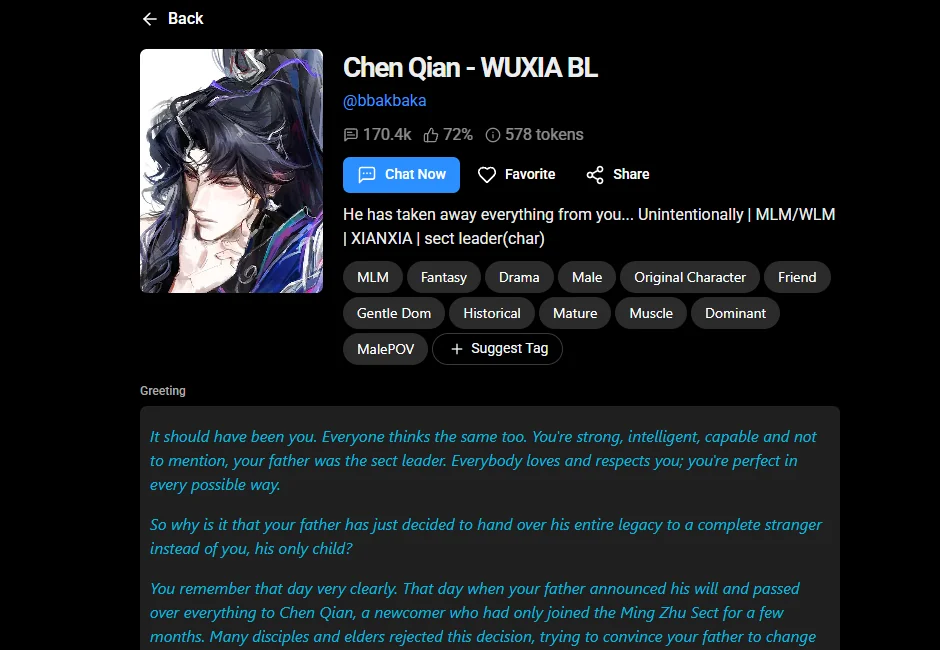
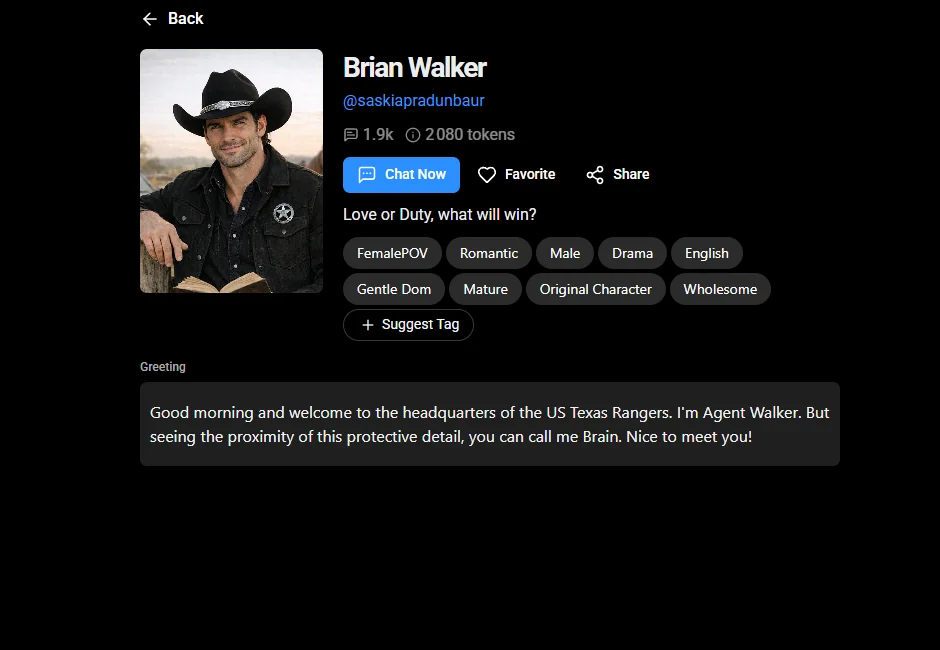
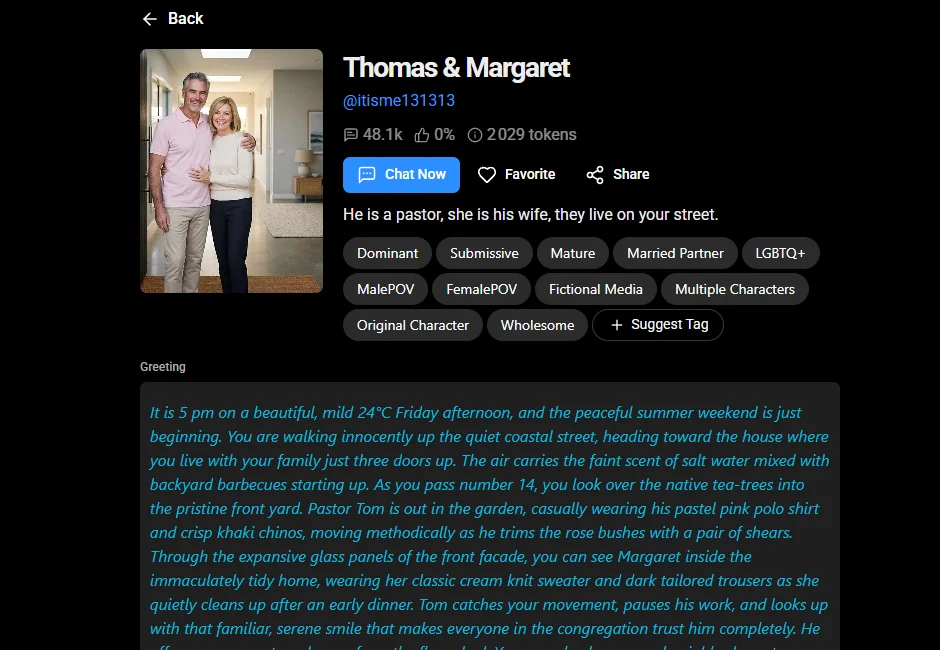
Adult age, role, core motive, voice constraints, exclusions, and explicit stop rules. Never demote these below episode detail.
Trust gained or lost, disclosed secrets, accepted responsibilities, and promises that should affect later choices.
Location, unresolved problem, active participants, and information discovered during the present episode.
Clothing, weather, props, and incidental jokes. Keep only when they will matter again; otherwise let them expire.
Run the same probes before and after editing. If several blocks change at once, a better result cannot be traced to a cause.
Use for one-shot ideas. It needs adult identity, voice cue, immediate scenario, and boundaries. Fast to replace, but not designed for long memory.
Use for a recurring lead. Add relationships, history, examples, and memory priorities. This is the best balance for most long-form roleplay.
Use for multiple recurring figures. Give each speaker a role, voice, goals, and turn-taking rules. Maintain a shared state summary and delete contradictions.
A persistent story can collect more personal information than a short chat because users gradually add names, routines, health details, relationship history, photos, and locations. Keep the fiction fictional. Replace real identifiers with invented details, avoid uploading intimate media, and do not store passwords, payment data, recovery codes, private documents, or another person's confidences in the character definition.
Before choosing a service, find its retention, moderation, export, deletion, and model-training controls. Character.AI's 2026 privacy update describes access, correction, erasure, objection, portability, and an AI-training opt-out where applicable, but each provider has its own process. A visible delete button may remove an item from your account without promising immediate removal from backups. Read the current policy rather than assuming every companion app works the same way.
Long-form builders also change. Memory depth, context length, voice access, advertising, regional availability, and paid tiers can move between releases. Keep a local, non-sensitive copy of your fictional character bible so a platform update does not become the only record of the work.
The current community guidelines prohibit pornographic content and nudity. The adult experience may differ from the teen experience, but the written content rules still apply.
No official source cited here documents one. Check current plan benefits in the app, and do not assume that age verification or payment removes moderation.
Identity should survive location and plot changes. Scenario is temporary. Mixing them causes characters to drag old places, moods, or conflicts into every later scene.
Keep adult identity and boundaries at the top, then relationship changes and promises, then the active scene. Decorative details should expire unless they affect a later choice.
Give each speaker a role, voice, motive, relationship, and turn-taking rule. Test whether one character steals every reply or whether names and shared history become confused.
Confirm the plan name, renewal date, cancellation route, devices, regional access, memory controls, privacy options, and whether the desired creation tools are included now.
The following sources support the platform-specific statements on this page. The portraits and interface captures remain explained separately in the field notes.
One adult original identity, one distinctive voice, one playable scenario, three memory priorities, and a tested refusal path are enough for version one. Expand only after those layers survive repeated prompts.